About the Human Data Catalogue
The Human Data Catalogue is a tool that aims to give visibility to human data. It initially focused on datasets used by INCEPTION teams, but now expands beyond the consortium to include other datasets. The Catalogue primarily features multimodal datasets, which enable richer, more comprehensive research.
Its purpose is to help researchers find useful human datasets and to foster a culture of open data sharing and of data findability. The Catalogue hopes to help bridge the gap between data generators and data users, fostering collaboration while maintaining respect for data privacy and integrity.
Why do we need a Human Data Catalogue?
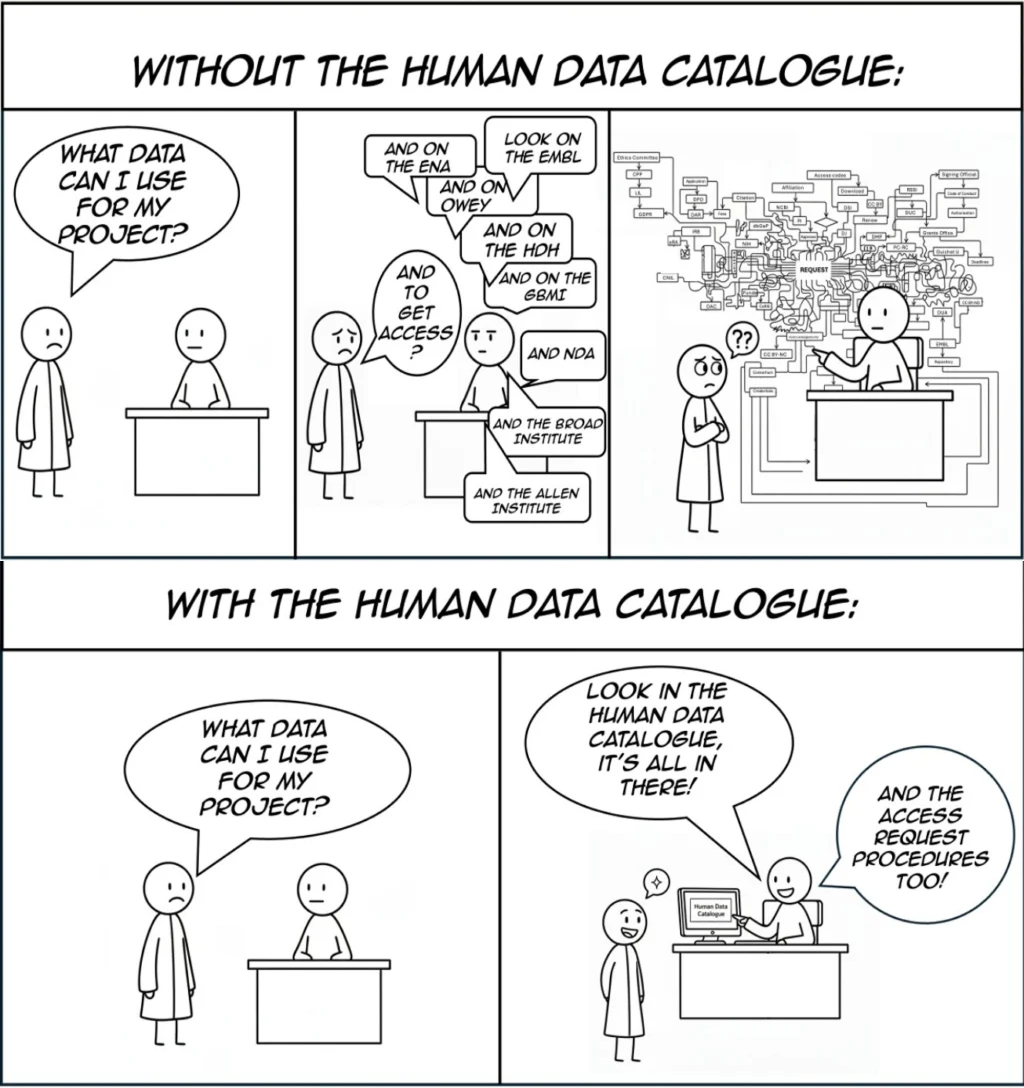
Modern biomedical research relies increasingly on large human cohorts and databases. Yet for researchers, identifying available resources, understanding their content and knowing how to gain access to them often remains a challenge in itself — even within an integrated research programme.
It is against this background that the Human Data Catalogue was born: a new structural initiative to make finding and accessing human data easier. Our ambition is to provide a single, clear and operational information hub that eliminates the time wasted tracking down the right contacts or piecing together administrative procedures scattered across multiple sources.
Methods
In May 2025, the INCEPTION consortium hired a project coordinator to identify all the human datasets that its teams were using (both from external teams and datasets that they had generated themselves). Throughout this process, 35 datasets were identified. Information about each dataset was then manually compiled into the Catalogue. Each description contains both scientific metadata and information on how to request access to the data.
Scope
We have chosen a broader definition of “dataset”, meaning it includes databases, datasets, and cohorts.
Only datasets containing human data are included in the Catalogue. This means that we have not included biobanks that exclusively contain samples with no data. The Catalogue includes datasets containing both raw individual data and aggregated-level data. In terms of access, we have included both open access and restricted-access datasets.
The Catalogue initially focused on listing human datasets used exclusively by INCEPTION teams. We now wish to broaden our scope to include datasets that are not used by INCEPTION teams, so as to extend our coverage to any dataset that could be useful for research involving human data. Any researcher can therefore add a dataset to the Catalogue, even if they are not part of the INCEPTION consortium.
The Catalogue is intended to grow as scientists contact our team to add new datasets to it; we therefore invite you to contact us by mail at humandatacatalogue@pasteur.fr if you would like to add a dataset to the Catalogue!
What the Catalogue DOES and DOES NOT do
✅ The Catalogue does:
Provide a search engine for finding human data
Describe each dataset with a set of metadata
Point to data access policies for each dataset
🚫 The Catalogue does not:
Host data
It only describes datasets with metadata.
Give you access to datasets directly
It only explains the procedure to follow in order to request access to the datasets.
Our team

Fanny Sébire
Fanny is a data librarian at the Scientific Information Resources Center of the Institut Pasteur. She has a background in neuroscience and information management.

Capucine Garnier-Muller
Capucine is the project coordinator for the Human Data Catalogue. She has a background in philosophy and public health and joined Institut Pasteur in June 2025 to carry out this mission.
Funding
The project of the Human Data Catalogue was funded by the INCEPTION consortium, Institut Pasteur and Institut Robert-Debré du Cerveau de l’Enfant.
The code of the project is : ANR-16-CONV-005.