
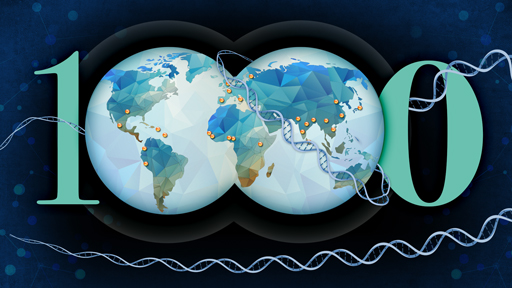
The 1 000 Genomes Project created a catalogue of common human genetic variation, using openly consented samples from people who declared themselves to be healthy. The 1000 Genomes Project ran between 2008 and 2015, creating the largest public catalogue of human variation and genotype data. Its goal was to find common genetic variants with frequencies of at least 1% in the populations studied. The International Genome Sample Resource (IGSR) maintains and shares the human genetic variation resources built by the 1 000 Genomes Project.

During the 1000 Genomes Project, the genomes of 2,504 people across five continental regions have been sequenced.
Raw and aligned sequence reads
SNPs, indels, and structural variant calls
Phased haplotypes and population-frequency information
The project reconstructed the genomes of 2,504 individuals from 26 populations using a combination of low-coverage whole-genome sequencing, deep exome sequencing, and dense microarray genotyping.
- 10.1038/nature09534: Durbin, R. M. et al. A map of human genome variation from population-scale sequencing. Nature 467, 1061–1073 (2010).
- 10.1038/nature15394: Sudmant, P. H. et al. An integrated map of structural variation in 2,504 human genomes. Nature 526, 75–81 (2015).
- 10.1038/nature15393: Auton, A. et al. A global reference for human genetic variation. Nature 526, 68–74 (2015).